Research
My current research in the GRIT group within CENTRA - IST with Prof David Hilditch
focuses on study of critical phenomena at the threshold of black hole formation through the collapse of gravitational wave initial data in axisymmetry.
My doctoral research at Florida Atlantic University before this
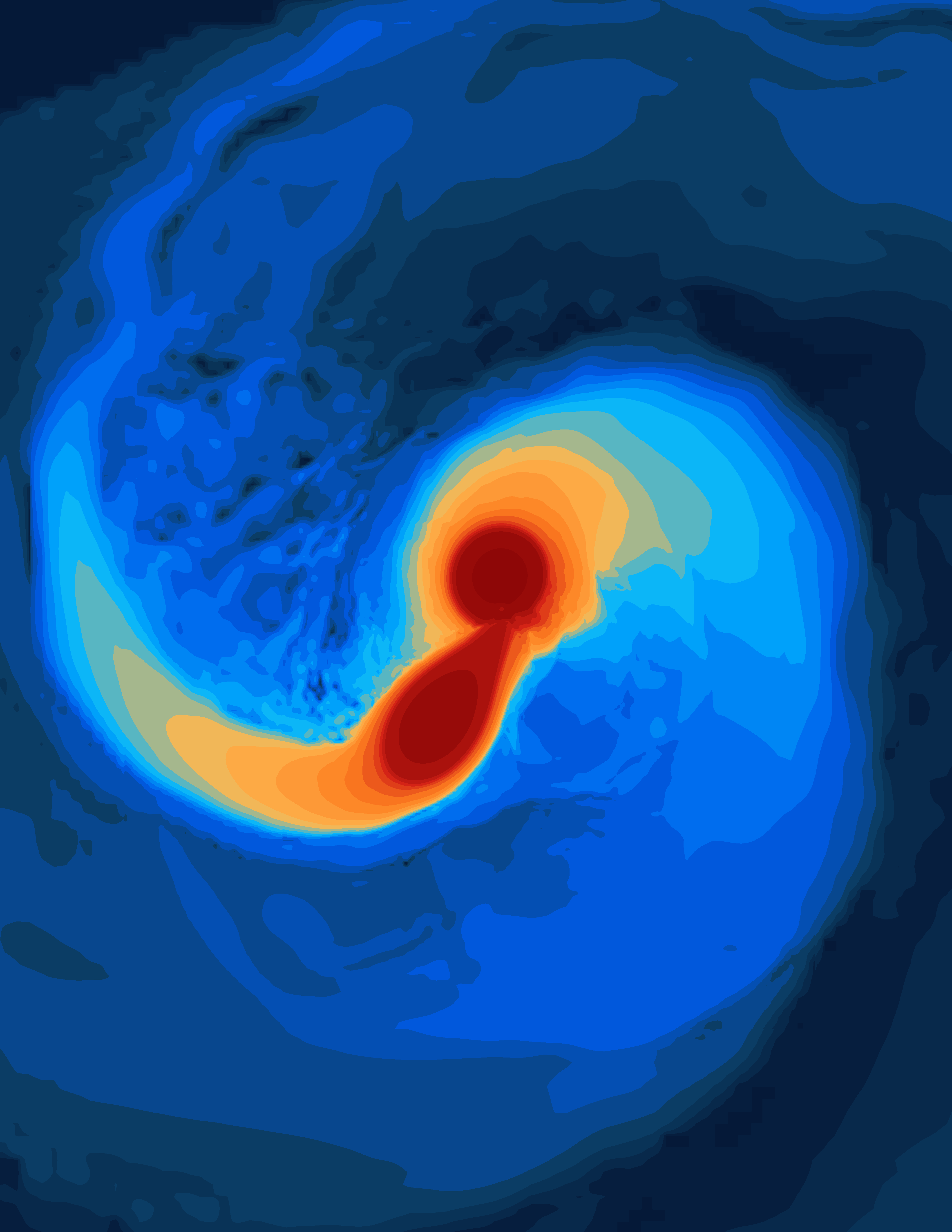
involved numerical relativistic simulation of compact objects, focusing principally on neutron stars (NSs),
under the supervision of Prof Wolfgang Tichy.
Gravitational Wave (GW) observation events, along with counterparts in other accompanying spectra,
ushered the current age of multimessenger astrophysics. Given this scenario, I worked on
simulating neutron stars with three objectives: (i) improving the accuracy and efficiency of the
simulating program, (ii) exploring new physics and NS configurations, and
(iii) investigating GW observation events through tailored simulations. Before my doctoral research, I studied Hawking radiation and Unruh effect,
involving quantum field theory on curved space-time.
Below are all the projects that I am working on currently and have worked on in the past.

Simulating neutron stars with the Nmesh program
Improving the discontinuous Galerkin method-based numerical relativity program, Nmesh,
specifically focusing on simulating neutron stars with higher accuracy
efficient results.
Related publication:
arXiv:2212.06340,
arXiv:2502.07204.
Dark matter admixed neutron stars
Spinning dark matter admixed neutron star inspirals and associated gravitational wave
signals and matter interactions.
Related publication:
arXiv:2502.07204.
Precessing eccentric binary neutron star inspirals
Simulating binary neutron stars with precessing spins and eccentric orbits with
the entropy-limited hydrodynamics (ELH) approach.
Analysing the LIGO GW190425 event
Modelling the GW190425 gravitational wave event by modeling it as a Binary Neutron Star
(BNS) merger event and studying the effect of different Equations of State.
Related publication:
arXiv:2109.04063,
arXiv:2210.16366.
Simulating a single black hole
Simulating a single black hole to test and optimize the new gravity evolution system
in the Nmesh program.
Fluctuation-dissipation relation in accelerated frames
Demonstrating how well-known non-equilibrium statistical phenomenon corresponding to the
fluctuation-dissipation theorem holds for the Unruh or Hawking radiation.
Related publication:
arXiv:1707.01333.